
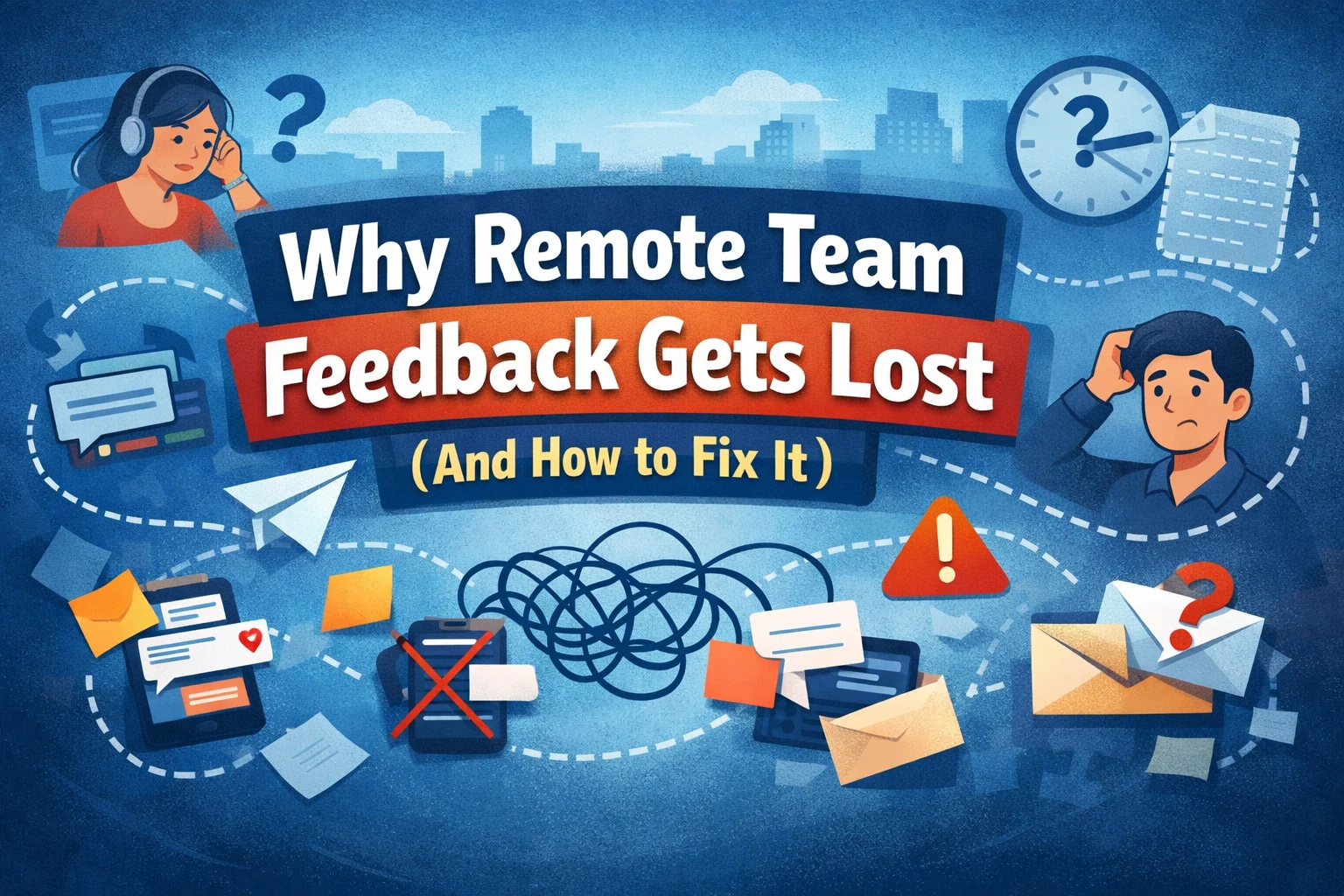
Remote work promised flexibility and speed, but for many teams it quietly introduced a new problem: remote team feedback getting lost, delayed, or misunderstood. Comments sit buried in Slack threads, decisions disappear after meetings, and critical feedback never reaches the right person at the right time.
If you have ever wondered why projects stall, revisions multiply, or teams feel misaligned despite constant communication, this blog explains why feedback breaks down in remote teams and how to fix it without adding more meetings or tools.
The Real Problem With Remote Team Feedback
Remote teams do not struggle because people are not communicating. They struggle because feedback is fragmented.
In distributed environments, feedback flows through:
- Slack messages
- Email threads
- Task comments
- Design tools
- Video calls
- Docs and spreadsheets
Each channel captures part of the conversation, but rarely the full context.
The result is simple. Feedback exists, but it is invisible, unstructured, and easy to miss.
Recent industry research supports this.
According to new industry insights shared across major business publications, feedback chaos has become a hidden bottleneck in modern product development, especially for distributed teams:
- AP News coverage:
https://apnews.com/press-release/marketersmedia/new-industry-insights-reveal-feedback-chaos-as-the-hidden-bottleneck-in-product-development-4997170268fa31c6bb37621ddd7f4599 - BarChart analysis:
https://www.barchart.com/story/news/36627124/new-industry-insights-reveal-feedback-chaos-as-the-hidden-bottleneck-in-product-development - MarketMinute feature:
https://fwnbc.marketminute.com/article/marketersmedia-2025-12-15-new-industry-insights-reveal-feedback-chaos-as-the-hidden-bottleneck-in-product-development
The takeaway is clear. Feedback chaos is not a communication problem. It is a system problem.
Why Feedback Gets Lost in Remote Teams
1. Too Many Tools, No Single Source of Truth
Remote teams often adopt tools reactively:
- Slack for quick chats
- Email for formal feedback
- Docs for notes
- Project tools for tasks
None of these tools are designed to own feedback end to end.
So feedback gets:
- Shared once
- Acknowledged briefly
- Forgotten quickly
Without a centralized feedback flow, teams rely on memory, and memory fails at scale.
2. Feedback Lacks Context
In remote setups, feedback is often text only:
- “This does not feel right”
- “Can we revise this?”
- “Something is off here”
But what exactly is wrong?
Without visual or contextual feedback, teams waste time clarifying instead of fixing. This slows momentum and frustrates everyone involved.
3. Asynchronous Communication Delays Decisions
Remote work depends on asynchronous communication, but feedback often needs timing.
When comments are left without:
- Clear ownership
- Priority
- Deadline
They sit idle. By the time someone responds, the context is gone or the work has already moved on.
4. Feedback Is Not Actionable by Default
Most feedback in remote teams is:
- Observational, not directive
- Opinion based, not outcome driven
If feedback does not clearly answer:
- What needs to change
- Who owns it
- By when
It becomes noise instead of progress.
The Hidden Cost of Poor Remote Team Feedback
Lost feedback does not just slow teams down. It creates compounding damage:
- Rework due to missed comments
- Friction between teams (“I already shared this”)
- Delayed launches
- Decision fatigue
- Reduced trust in collaboration tools
As highlighted in the industry reports above, feedback chaos directly impacts speed, quality, and morale, yet most teams do not notice it until delivery suffers.
How to Fix Remote Team Feedback (Without More Meetings)
Fixing feedback is not about communicating more. It is about communicating better.
1. Centralize Feedback by Context, Not Channel
Feedback should live where the work lives:
Instead of referencing feedback elsewhere (“See Slack”), attach it directly to the asset. This reduces cognitive load and eliminates guesswork.
2. Make Feedback Visual and Specific
High performing teams use visual feedback:
- Click based comments
- Annotations
- Screenshots or recordings
Visual feedback removes ambiguity and shortens feedback loops, especially in design, product, and marketing teams.
3. Separate Discussion From Decisions
Not all comments are equal.
Effective remote teams clearly distinguish:
- Discussion, ideas and opinions
- Decisions, what will change
When feedback turns into a decision, it should be explicit, documented, and trackable. This prevents repeated debates and circular revisions.
4. Assign Ownership to Feedback
Unowned feedback is ignored feedback.
Every meaningful comment should have:
- A clear owner
- A visible status, open, in progress, resolved
This turns feedback from conversation into execution.
5. Use Purpose Built Feedback Workflows
This is where many teams quietly evolve.
Instead of forcing feedback into chat or project tools, they adopt dedicated feedback workflows. These are often lightweight platforms designed specifically for visual, contextual collaboration.
Some teams use tools like BugSmash to collect feedback directly on live assets, keep discussions centralized, and ensure nothing slips through the cracks. The focus is not the tool itself, but designing feedback as a first class workflow.
What High Performing Remote Teams Do Differently
Teams that do not lose feedback consistently follow these principles:
- They reduce feedback surfaces, not increase them
- They prioritize clarity over speed
- They treat feedback as a system, not a message
- They design workflows around outcomes, not opinions
As highlighted in the recent industry insights, companies that fix feedback chaos do not just move faster. They make better decisions with less friction.
FAQs About Remote Team Feedback
Why does feedback fail more in remote teams than in office teams?
Because remote feedback lacks shared physical context and relies heavily on fragmented digital tools.
Is Slack enough for managing feedback?
Slack is effective for discussion, but poor for tracking, prioritizing, and resolving feedback long term.
What is the biggest mistake remote teams make with feedback?
Assuming feedback was seen just because it was sent.
How can teams reduce feedback overload?
By centralizing feedback, making it visual, and assigning ownership.
Do feedback tools replace communication?
No. Feedback tools structure communication so it leads to action instead of confusion.
Conclusion
Remote work is not broken, but remote team feedback often is.
Feedback gets lost not because teams do not care, but because it is scattered, context-poor, and unmanaged. Industry research now confirms feedback chaos is one of the biggest hidden bottlenecks in modern remote work.
The fix is not more messages or more meetings.
It is clearer systems, visual context, and intentional workflows.
When feedback becomes visible, actionable, and centralized, remote teams stop chasing clarity and start shipping better work, faster.




Leave a Reply