
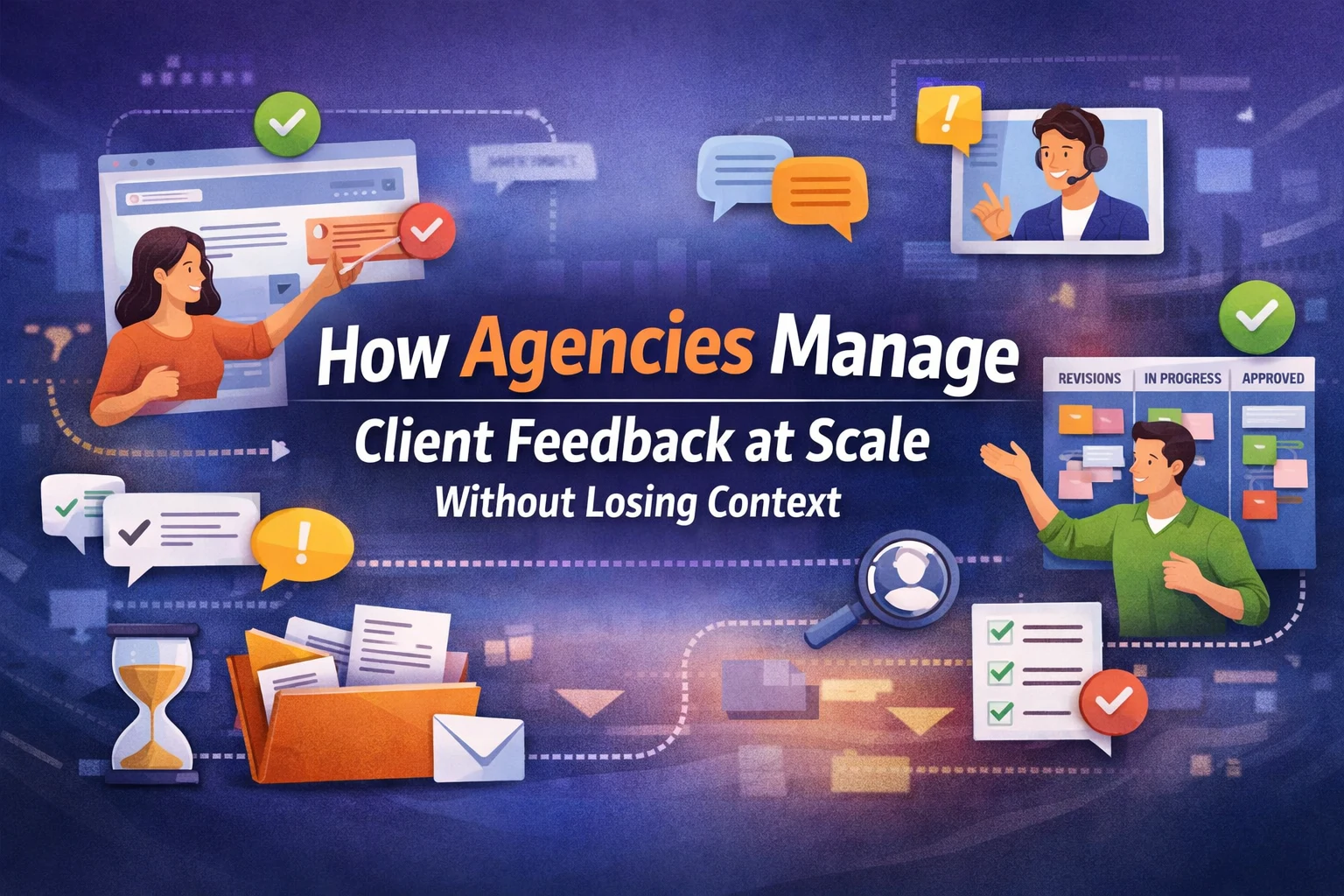
As agencies grow, client feedback management becomes one of the hardest problems to scale. What works with two clients completely breaks with twenty. Feedback starts living in emails, WhatsApp messages, Google Docs, Loom videos, Slack threads—and suddenly no one knows which comment is final, which version is approved, or what still needs fixing.
This blog breaks down how modern agencies manage client feedback at scale without losing context, clarity, or sanity. You’ll learn the real problems agencies face, why feedback chaos happens, and the systems, workflows, and tools that high-performing agencies use to stay organized while handling dozens (or hundreds) of client inputs simultaneously.
If you run an agency and feel like feedback is slowing delivery more than execution—this is for you.
Why Client Feedback Breaks at Scale
Feedback doesn’t fail because clients are “difficult.” It fails because systems aren’t built to scale communication.
Here’s what typically goes wrong as agencies grow:
- Feedback arrives across multiple channels
- Comments lack visual or technical context
- Clients review outdated versions
- Teams interpret feedback differently
- No clear ownership or resolution tracking
At small scale, teams “manage” this manually. At scale, manual coordination collapses.
That’s where structured client feedback management becomes a business-critical function—not an afterthought.
The Hidden Cost of Poor Client Feedback Management
Most agencies underestimate how expensive feedback chaos really is.
Poor feedback systems lead to:
- Rework due to misunderstood comments
- Delayed timelines and missed deadlines
- Burnout across design and development teams
- Friction between account managers and delivery teams
- Frustrated clients who feel “ignored”
The biggest cost? Lost context.
When context is missing, teams don’t know:
- Where the issue exists
- Why the client flagged it
- What version it applies to
Fixing the wrong thing is worse than fixing nothing.
How High-Scale Agencies Actually Manage Client Feedback
Successful agencies don’t rely on more meetings or more documentation. They rely on systems.
1. Centralize All Client Feedback
At scale, feedback must live in one system, not many.
Best-in-class agencies:
- Eliminate feedback via email and chat
- Route all client comments into a single review flow
- Maintain a single source of truth per asset
This alone reduces confusion by 50% or more.
2. Make Feedback Visual by Default
Text-only feedback is the fastest way to lose context.
High-performing agencies insist on:
- Click-based comments on designs or websites
- Timestamped feedback for videos
- Annotations instead of paragraphs
Visual feedback removes interpretation. Teams see exactly what the client means—no guesswork.
3. Separate Feedback From Conversation
A common mistake agencies make is mixing discussion with actionable feedback.
Smart agencies separate:
- Feedback → what needs to change
- Discussion → why it needs to change
This keeps delivery focused and prevents endless opinion loops.
Client Feedback Management Requires Version Discipline
One of the biggest scaling problems is version confusion.
Agencies that scale well enforce:
- Clear version naming conventions
- Feedback locked to specific versions
- No feedback accepted on outdated links
This prevents teams from fixing things that no longer exist.
How Agencies Maintain Context Across Teams
As agencies grow, more people touch the same project. Context gets diluted fast.
4. Attach Metadata to Every Feedback Item
High-scale agencies ensure feedback always includes:
- Page or asset reference
- Environment (live, staging, preview)
- Priority or severity
- Ownership (who fixes it)
This allows feedback to move smoothly from:
Client → Account Manager → Designer → Developer
Without repeated explanations.
5. Assign Ownership, Not Just Tasks
Feedback without ownership doesn’t get resolved—it gets discussed.
Scalable agencies:
- Assign every feedback item to a clear owner
- Track status (open, in progress, resolved)
- Close the loop with visible resolution
This builds client trust and internal accountability.
The Role of Tools in Client Feedback Management
No agency manages feedback at scale using inboxes and spreadsheets alone.
Modern agencies use:
- Visual feedback platforms
- Integrated task tracking
- Notification-based updates
- Client-friendly review interfaces
Some teams pair delivery tools with dedicated feedback platforms (for example, visual collaboration tools like BugSmash) to ensure feedback stays contextual, versioned, and review-ready—without forcing clients to learn complex systems.
The key isn’t the tool—it’s enforcing one feedback workflow.
Common Mistakes Agencies Make When Scaling Feedback
Even experienced agencies fall into these traps:
- ❌ Allowing feedback via “just this once” emails
- ❌ Accepting feedback without visuals
- ❌ Letting clients comment on old versions
- ❌ Treating feedback as discussion instead of action
- ❌ Not closing the feedback loop
Scaling requires discipline, not flexibility.
What a Scalable Client Feedback Workflow Looks Like
Here’s a simple, scalable feedback loop agencies use:
- Share a single review link
- Client leaves visual, contextual feedback
- Feedback is automatically organized
- Team reviews, assigns, and resolves
- Client sees updates and approvals clearly
No chasing. No confusion. No lost context.
FAQs: Client Feedback Management at Scale
What is client feedback management?
Client feedback management is the structured process of collecting, organizing, tracking, and resolving client input across projects without losing context or clarity.
Why does feedback become harder as agencies scale?
More clients, assets, and stakeholders increase communication complexity. Without systems, feedback fragments across tools and teams.
How can agencies prevent feedback misinterpretation?
By making feedback visual, version-specific, and centralized—rather than text-based and scattered.
Do agencies need separate tools for feedback?
Not always, but many use dedicated feedback platforms alongside project management tools to preserve context and speed up reviews.
What’s the biggest mistake agencies make with client feedback?
Letting feedback come in through multiple channels and formats without a clear, enforced workflow.
Conclusion
Scaling an agency isn’t just about winning more clients—it’s about handling complexity without losing control. And nothing creates chaos faster than unmanaged feedback.
Agencies that master client feedback management don’t rely on heroics, long meetings, or constant follow-ups. They rely on structured workflows, visual context, clear ownership, and disciplined systems.
When feedback is centralized, visual, and versioned, teams move faster, clients feel heard, and delivery stops being a bottleneck.
At scale, clarity isn’t optional—it’s the competitive advantage.




Leave a Reply