
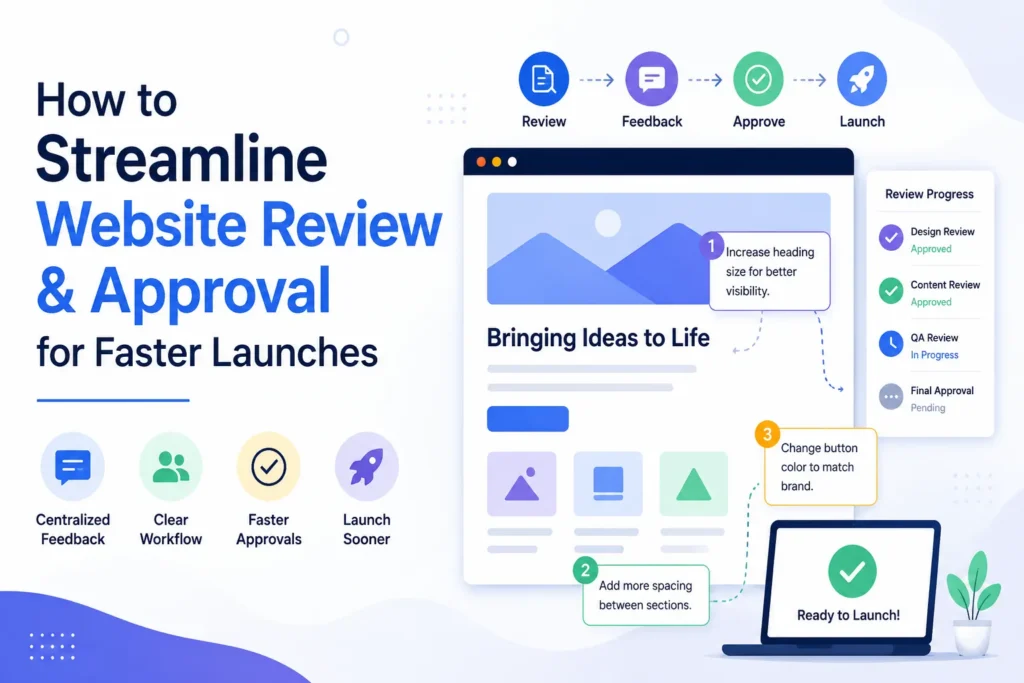
Most websites are not delayed because developers move too slowly.
They get delayed because feedback arrives late, approvals keep changing, comments are scattered across five tools, and nobody knows who makes the final decision.
A website can be technically finished and still sit in review for days or weeks.
That is why improving your website review process has become one of the highest-leverage ways to launch faster without sacrificing quality.
- Define review stages before development starts
- Centralize website feedback in one workflow
- Replace vague comments with visual feedback
- Limit approval layers and assign ownership
- Track revisions without restarting decisions
This guide explains how modern teams streamline reviews, reduce approval friction, and launch websites faster.
The Hidden Reason Website Launches Slow Down
Most teams expect delays during design or development.
What catches them off guard is what happens after the build.
A website enters review and suddenly:
- Stakeholders request changes they never mentioned before
- Feedback appears in Slack, email, and meetings
- Teams revisit already-approved decisions
- Clients ask for “small tweaks” that create new rounds
The launch timeline stretches.
Not because work is hard.
Because decisions are messy.
The strongest teams do not review more. They review better.
What Is a Website Review Process?
A website review process is the structured system used to collect feedback, approve changes, validate quality, and move a website toward launch.
A strong review process answers three questions:
- Who reviews?
- What gets reviewed?
- When is something considered approved?
Without those answers, reviews become open-ended.
Build Approval Into the Project From Day One
- One mistake appears repeatedly.
- Teams treat approval as the final step.
- It should be designed into the project from the beginning.
- Create approval checkpoints early:
Example Workflow
Phase 1: Wireframe approval
Confirm structure and user flow.
Phase 2: Design approval
Validate visual direction.
Phase 3: Content approval
Lock messaging and SEO elements.
Phase 4: Development review
Check implementation accuracy.
Phase 5: Launch sign-off
Approve final readiness.
Each phase should close decisions instead of reopening them.
Stop Collecting Feedback Everywhere
Feedback chaos is one of the biggest launch killers.
This happens constantly:
- Designer receives comments in Figma.
- Developer receives screenshots in Slack.
- Client sends email notes.
- Project manager keeps updates in spreadsheets.
- Nobody knows which feedback is current.
Instead:
- Use one review location
- Keep conversations attached to context
- Track decisions visibly
- Close resolved comments
This is one reason visual collaboration platforms such as BugSmash are becoming part of modern website delivery workflows. They remove the effort of organizing feedback manually.
Use Visual Feedback Instead of Interpretation
- Traditional comments create interpretation.
- Visual feedback creates action.
- Compare the difference.
Weak feedback:
❌ “Homepage needs work.”
❌ “Make it more modern.”
❌ “Improve spacing.”
Actionable feedback:
✅ “Move CTA above the fold.”
✅ “Increase mobile padding below hero.”
✅ “Reduce card width for readability.”
Visual reviews reduce explanation time because reviewers point directly to what needs attention.
The fewer assumptions teams make, the faster they ship.
Reduce Stakeholder Friction Before It Starts
- More reviewers rarely produce better outcomes.
- They usually produce slower outcomes.
Create three levels of involvement:
Decision Makers
Approve and move projects forward.
Contributors
Suggest improvements.
Observers
Stay informed but do not create blockers.
This simple structure removes endless approval loops.
Turn Reviews Into Decisions, Not Discussions
Many review meetings end with:
“We’ll revisit later.”
That phrase quietly kills launch speed.
Every review should end with one outcome:
- Approved
- Approved with revisions
- Rejected with clear actions
No middle ground.
Teams that do this well move faster because each review creates momentum.
Track Revisions Without Losing Context
Version confusion creates hidden delays.
Questions begin appearing:
Which version is approved?
Which feedback is outdated?
What changed since last review?
Instead of restarting conversations:
- Maintain version history
- Connect comments to revisions
- Archive completed decisions
- Track approval timestamps
The goal is simple.
Every update should move forward, not backward.
Create a Launch Readiness Checklist
Before launch, remove emotion from approvals.
Use objective criteria.
Design
✔ Responsive across devices
✔ Visual consistency approved
Content
✔ Final copy approved
✔ SEO completed
Functionality
✔ Forms tested
✔ Navigation verified
Performance
✔ Speed reviewed
✔ Tracking implemented
Stakeholders
✔ Final sign-off received
Launches become faster when approval becomes measurable.
What High-Performing Teams Do Differently
Teams that consistently launch faster usually share these habits:
- They review continuously instead of all at once
- They give feedback visually
- They limit who approves
- They centralize communication
- They close decisions quickly
Their advantage is not working harder.
It is reducing friction.
FAQs About Website Review & Approval
1. What is a website review process?
It is the structured workflow used to review, revise, approve, and launch websites efficiently.
2. Why do website launches get delayed?
Most delays happen because of scattered feedback, unclear ownership, and repeated approval cycles.
3. How does visual feedback improve reviews?
Visual feedback reduces ambiguity and allows teams to resolve issues faster.
4. Who should approve a website before launch?
Usually project managers, stakeholders, QA teams, and clients depending on the workflow.
5. How can agencies speed up website approvals?
By centralizing reviews, reducing approval layers, and creating structured decision points.
Conclusion
Website launches are rarely delayed because teams cannot build.
They are delayed because teams struggle to decide.
A better website review process creates clarity, shortens approval cycles, and removes unnecessary friction from delivery.
When reviews become visual, feedback becomes centralized, and approvals become structured, launches stop feeling unpredictable.
The goal is not to move faster for the sake of speed.
The goal is to create a review system that lets great work go live without unnecessary delay.